
Those Who Can’t Do, Teach
At 18, my teacher took me into the woods and showed me what love is

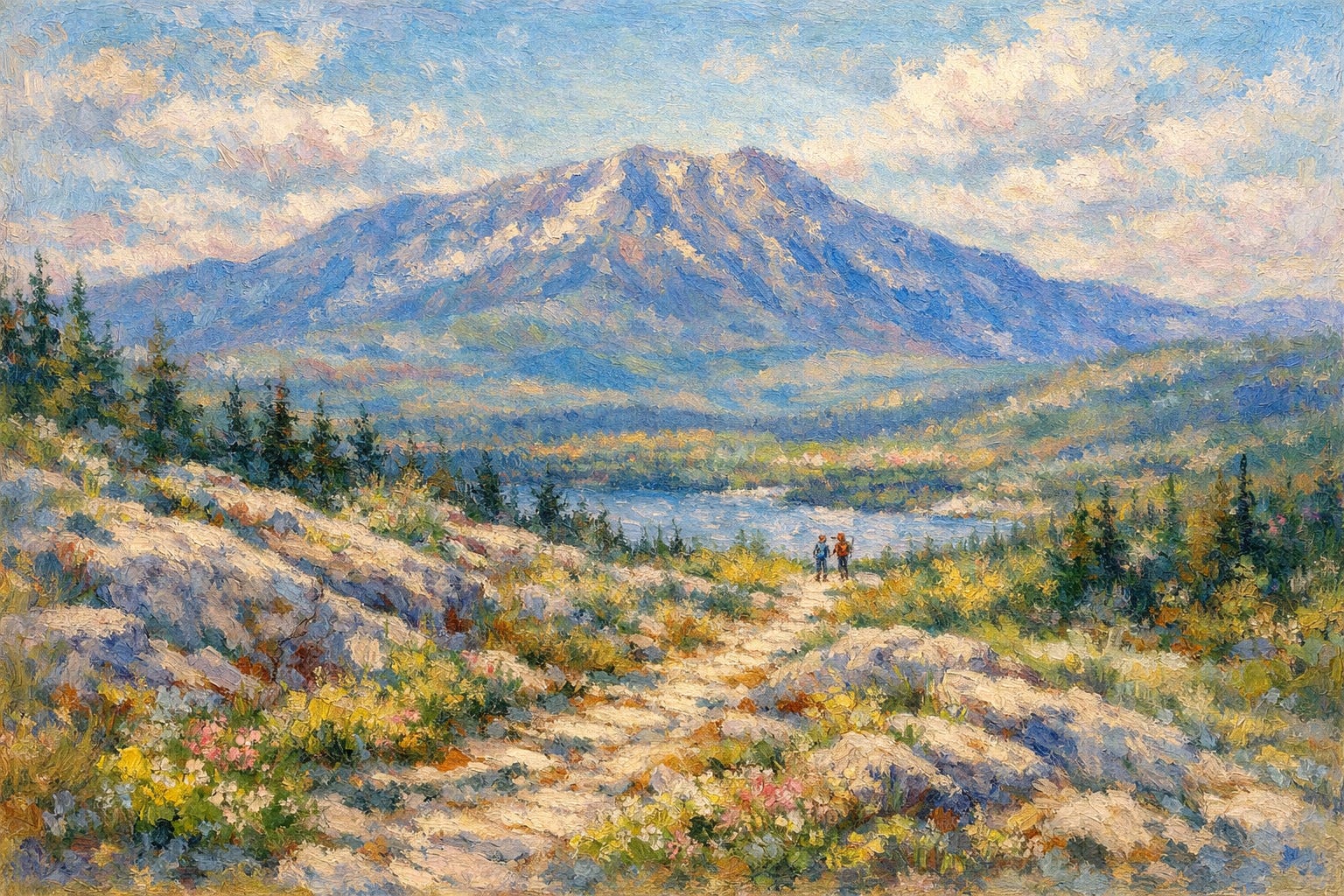
Huddled in the backseat of a Subaru, I watched the last signs of civilization morph into one lane dirt roads as Maine’s northern woods blurred past. I kept checking my phone in desperation, although I knew it was useless. We were too far north, and I no longer had a signal.
“What’s your favorite flavor of beer?” Adam asked from the passenger seat. “We’re going to stop and get gas in a bit.”
Justin, my high school teacher, glanced at me, then at his brother-in-law. He seemed annoyed by the question at first, then smiled sheepishly. “I didn’t hear or see anything.”
“Damn right you didn’t,” Adam snapped. “We’ve got a lot of time to kill.”
When Justin, my former physical teacher, told me in April he wanted to run 100 miles during the dog days of summer along the northernmost point of the Appalachian Trail, I knew what was coming next: He wanted me to run the race with him. After a rough first semester in college, I transferred schools to be closer to my high school girlfriend, and due to my decision to move home, I became his early morning running partner. Justin and I grew close in high school when he took me under his wing and helped me lose 50 pounds. Now, at 18 with no commitments and a bit of a wild streak, I was the ideal candidate to sit in the woods for three days.
I agreed—but he was lucky he asked when he did. A few weeks later, I discovered my girlfriend was cheating on me. When she started openly seeing the guy, I became so depressed that I contemplated suicide. I stopped answering Justin’s texts and pretty much quit running altogether. Instead, I spent all my energy checking my ex’s Twitter, lifting weights until I almost vomited, and starving myself to get abs in an effort to win her back.
It worked enough to confuse us both; although she was still seeing the other guy, my ex invited me on her family’s vacation to Wells Beach in August, which happened to be the week leading up to Justin’s race.
Checking in, Justin’s message read, one day in July. Are you still good for the race?
Part of me hoped he’d forgotten about it. I asked if he could pick me up in Wells.
Sure.... Then a second message: You been training?
I was vague in my text back, and even quieter on the three-hour ride to Monson. Justin said it would be good if I could join him at mile 69 and run the final 50 kilometers together. I had no idea if I could, but I said okay. For the next 24 hours, Justin ran while Adam and I drank Budweiser at the aid stations, only stopping long enough to sober up and drive down log roads to the next checkpoint. He completed 55 miles by dinner time; this meant I would likely join him on trail around midnight. We got to the next checkpoint early so I could nap, but I couldn’t fall asleep. So I drank more beer and watched the stars, thick like magnets on a refrigerator, and thought about my awful summer.
By 1:30am, Justin still wasn’t at the aid station. We started to get worried, until an hour later, just before I was going to look for him, we saw the feeble bounce of a headlamp coming towards us from the woods.
“How are you doing?” I asked.
“I don’t know,” a ghost-like Justin muttered, breathless.
“You don’t know what?”
“I don’t know,” he repeated, avoiding eye contact. He collapsed into a lawn chair.
Justin and I had run together over a hundred times. I had never seen him like this. Our runs were, almost exclusively, an exercise in humility for me: we met at 4:20am on weekdays and ran seven hard miles on rocky single track or sandy power line trails all over central Massachusetts. Justin was fit and ruthless. He’d stay with me for a mile, then put the burners on and leave me by myself. I mostly hated these runs, but I almost always showed up anyway, because pushing myself to the brink physically was the only reliable strategy I had for feeling good about myself.
Now, Justin’s cheeks were pale, and his quivering legs were caked in mud and blood. The aptly named 100-Mile Wilderness had chewed him up, and I could tell he was doubting his ability to finish.
After thirty minutes of rest and some electrolytes, he rose to his feet. “Let’s go,” he said. But we only ran long enough to get out of view of Adam—maybe 400 yards—before he started walking again, with the gait of a wounded drunkard. I hid my concern as the trail forced us to scramble down the side of a mountain on all fours, sidestepping loose limestone. If he fell, we had no way to get help.
“Take another salt tablet,” I said. “And drink more water, if you can.”
He listened, but most of it dribbled down his chin. By the time the sun came up four hours later, we had only gone six miles. The peak of Mount Katahdin was still twenty five miles away.
“I hate this. I fucking hate this,” he muttered under his breath over and over, clearly holding back tears. “Tell me a story, Ben. Anything to distract me. What kind of crazy stuff have you been up to?”
Occasionally, Justin indulged my wild college stories on training runs with detached amusement. It dawned on me that I had nothing to share, because I spent the entire summer grieving in my mom’s basement. So I went into great detail about the breakup, how my ex and I kept torturing each other by refusing to let go, how I’d gone on vacation with her and slept in a child’s bunk bed in a separate room all week before he and Adam picked me up.
Then, figuring I had nothing to lose, I told him I had seriously considered killing myself.
Justin said nothing. In fact, neither of us spoke for several minutes. Just as I started thinking I should have left out the part about killing myself, he began muttering again.
“I m-m-m-miss my wife.”
“What?”
He began sobbing hysterically and shouting. “I miss my wife! I miss her! I l-l-love her so m-m-much, Ben!”
For the next hour, Justin gushed crocodile tears and shouted his wife’s name into the deciduous void. It was like watching someone I didn’t know give birth.
Because our pace was so slow—and because Justin could no longer hold down solid food—we both knew his race was effectively going to end at the next aid station—14 miles short of his goal. Adam was ready to talk Justin out of it, until he saw the face I made behind his back. We packed up the car and drove to a grocery store in Augusta for breakfast. I hadn’t slept for 40 hours.
As we re-entered civilization, my phone started buzzing again, and the what-if scenarios that had plagued me all summer picked up right where they left off. Would she say our trip was good enough to get back together? I wondered. Would she leave the other guy?
We continued our toxic cycle for a while, but things petered out, which empowered me to transfer back to my original college in the fall.
Until recently, I described this three-day stretch with my teacher along the Appalachian Trail as perhaps the most awkward event of my life. Justin changed my life by being a role model at a time in high school when I desperately needed one, and seeing him completely broken like that was something I’d rather forget.
Yet now I see that description was another naive translation of my mentor’s lessons. At the time, I only understood discipline: hard work was the de-facto antidote to solving life’s problems, and I held onto that as a rigid blueprint for far too long. It’s taken longer than I care to admit, but now, I see how, at the tail end of one of the lowest points in my life, the man who taught me how to lift weights and eat like an adult passed along another lesson about loving others. Namely, that grit is not—and cannot—be the only thing that helps men climb mountains.